
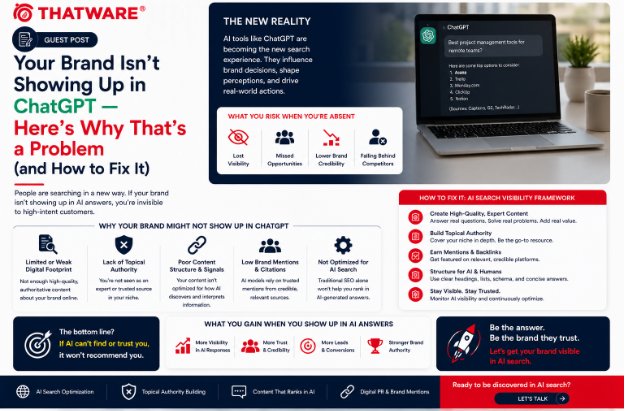

There’s a quiet shift happening in how people find information — and most businesses haven’t noticed yet. Or maybe they’ve noticed, but haven’t quite figured out what to do about it.
Think about the last time you Googled something. Did you actually scroll through ten blue links? Or did you glance at the AI Overview at the top, read two sentences, and call it a day? That’s what millions of people are doing right now. And increasingly, they’re skipping Google altogether — going straight to ChatGPT, Perplexity, or Gemini and just asking. Conversationally. Like they’re talking to a colleague.
That’s not the future. That’s Tuesday.
So if your brand isn’t showing up in those answers — if ChatGPT doesn’t know you exist, or worse, recommends a competitor instead — you have a real visibility problem. And the old playbook of keyword stuffing and backlink farming? That won’t fix it.
The Old SEO Rules Don’t Fully Apply Anymore
Here’s the thing about traditional SEO: it was built around search engines that crawled pages, matched keywords, and ranked based on backlinks. Optimize for those signals and you’d show up. Simple enough — even if the execution was never actually simple.
But large language models don’t rank pages the same way. They synthesize. They pull from training data, real-time retrieval, and indexed content to construct an answer. They’re not handing you a list of links — they’re making a judgment call about which brands, experts, and sources are credible enough to mention.
Getting into that judgment? That’s a completely different game. You need entity recognition. Structured data. Semantic authority. Consistent brand signals across the web. It’s less about “rank #1 for this keyword” and more about “does the model understand who we are and trust us enough to cite us?”
That’s a nuance most traditional SEO agencies aren’t equipped to handle. Which brings us to something worth talking about.
What an AI-Native SEO Agency Actually Does
Not all SEO agencies are equal — and right now, that gap is wider than ever. Some are still running the same 2019 playbook with a coat of “AI” paint slapped on the website. Others are genuinely rethinking what search optimization means in an era of generative AI.
A real AI-powered SEO agency isn’t just using AI tools to write faster blog posts. It’s building a methodology around how LLMs are trained, how they retrieve information, and how brands can signal expertise in ways that machines — not just humans — can interpret and trust.
That means doing things like:
-
Building semantic content clusters that establish topical authority (not just targeting isolated keywords)
-
Optimizing for entities and structured data that AI systems can parse cleanly
-
Creating the kind of credibility footprint that LLMs treat as a reliable source
-
Monitoring brand mentions and citations across AI-generated outputs — not just SERP rankings
It’s deeper work. More technical. And honestly, more interesting than writing another “Top 10” listicle for a keyword with decent volume.
Why ChatGPT Visibility Is Worth Caring About Right Now
Some marketers are still treating ChatGPT visibility as optional — a nice-to-have for the future. That’s a miscalculation.
According to various usage reports, ChatGPT crossed 100 million weekly active users faster than almost any platform in history. And it’s not just casual users experimenting — professionals, researchers, executives, and everyday consumers are actively using it for buying decisions, vendor comparisons, industry recommendations. When someone asks ChatGPT “what’s the best project management software for a small team?” or “which marketing agency should I hire for e-commerce growth?” — those answers shape real decisions.
If your brand is absent from those answers, you’re absent from part of the consideration set. And that share of mind translates, eventually, into market share.
The best AI SEO agency for visibility in ChatGPT / Google AI Overviews will understand that these aren’t two separate channels — they’re both expressions of the same underlying shift. AI-generated answers, whether from Google or from OpenAI, are pulling from overlapping signals. Authority, clarity, semantic structure, entity recognition — these matter across both.
What to Look for When Choosing an Agency
This is where brands often get tripped up. “AI SEO” has become a buzzword, and everyone’s slapping it on their service pages. So how do you tell the real from the repackaged?
A few things to actually look for:
Transparency about methodology. Not vague promises about “leveraging AI,” but a genuine explanation of how they approach entity optimization, LLM citation analysis, and structured data. If they can’t explain it without waving their hands, move on.
Experience with generative search. Have they actually tracked brand mentions inside ChatGPT, Perplexity, or Google’s AI Overviews? Do they know how to measure performance in an environment without traditional rankings?
Content strategy that goes beyond keywords. Are they thinking about content as a way to build genuine topical authority? Or are they still running keyword-density checks and celebrating position #3 for a term that gets 90 searches a month?
Technical depth. Schema markup, knowledge graph optimization, structured data for AI parsability — these are table stakes now. If the agency doesn’t talk about these things fluently, that’s a signal.
One agency worth looking at seriously is ThatWare. They’ve built out what’s probably one of the more sophisticated frameworks for LLM-era SEO — combining semantic AI, neural graph optimization, and entity-based content architecture in a way that’s actually built for how generative AI works, not just adapted from old methods. If you’re evaluating options, their work on the best AI SEO agency is a solid place to start understanding what real AI-native SEO looks like in practice.
The Semantic Web Is Back — Sort Of
Here’s an interesting bit of context. In the early 2000s, there was a lot of excitement about the “semantic web” — the idea that content could be structured so machines could understand meaning, not just match text. It kind of stalled out. Never fully materialized the way people hoped.
But LLMs have quietly made it relevant again. Machines can now understand context, nuance, and relationships in ways that keyword-based algorithms couldn’t. And brands that structure their content and data with that understanding in mind — using schema, building knowledge bases, creating internally coherent content clusters — are going to be at a significant advantage.
It’s not about gaming the algorithm. It’s about being genuinely understood by the systems that increasingly mediate how people find information.
Don’t Wait for This to Feel Urgent
One last thing, and it’s genuinely important: the brands building LLM visibility now are going to be very hard to displace once those citation patterns solidify. AI systems develop preferences over time. If a model consistently pulls from a particular source, that source gets reinforced in training data, in retrieval weighting, in user trust. Early mover advantage is real here.
Waiting until ChatGPT visibility “becomes mainstream” is a bit like waiting until 2018 to start thinking about mobile SEO. Technically still possible to catch up — but you’d be playing from behind.
The smartest thing you can do is start now, work with people who genuinely understand how this landscape works, and build the kind of brand presence that AI systems can actually see, interpret, and trust.
That’s not a complicated idea. But the execution — the structured data, the semantic architecture, the entity optimization, the continuous monitoring across generative platforms — that’s where working with the right AI-powered SEO agency makes all the difference.
Because in the end, visibility isn’t just about being found. It’s about being chosen — by algorithms, and the people who trust them.